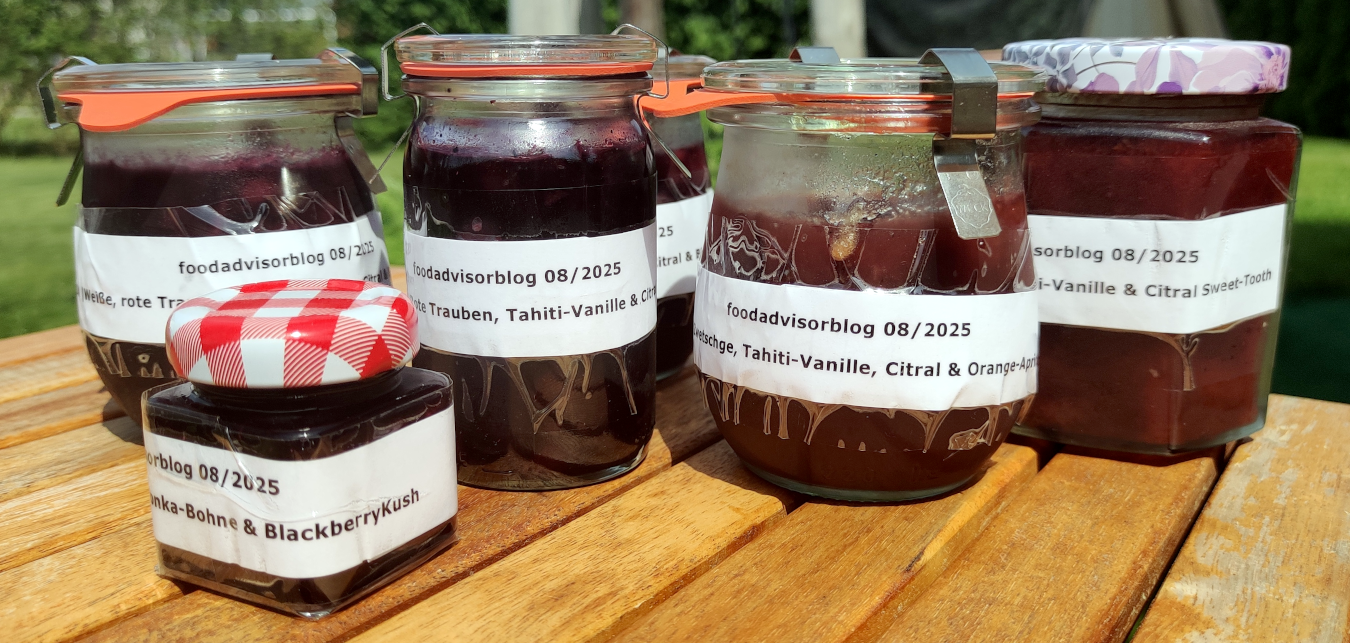
 Jams with Tonka Bean and/or Tahitian Vanilla and Terpenes
It doesn’t happen very often that we make jam – but once a year, when our grapes are ripe, the time has come.

Not that our grapes – red & pale green – are anything special; we apparently just had some luck with the plants we bought, because our two vines now yield almost 8kg of grapes annually.

The dark red ones account for about 70-75% in terms of quantity, which we don’t really mind, as they are simply a bit more robust in flavour.

I would like to preface this by saying that we prefer our jams to have a bit more bite when it comes to the fruit. Therefore, we deliberately do not puree the fruit, but rather take the trouble to halve every grape regardless of size and manually “free” them from their seeds. The smallest fruit pieces are therefore half grapes at most.

Fundamentally, any jam recipe can be refined with terpenes, which is why we can only provide an example with our grapes and point out the “pitfalls” we encountered.

We divided the fruits into different pots and let them boil while stirring for only 8-10 minutes each, so that the texture and crispness are preserved.

It is advantageous to let the grapes steep with the tonka bean and/or vanilla, the pinch of salt, and the preserving sugar for a few hours – or even overnight if it isn’t too warm – before boiling.
As for the flavours besides the terpenes, I have been using Tahitian vanilla (Vanilla tahitensis) for quite some time.


It brings a significantly more complex body as well as floral nuances and additionally saves sugar – a classic win-win situation.
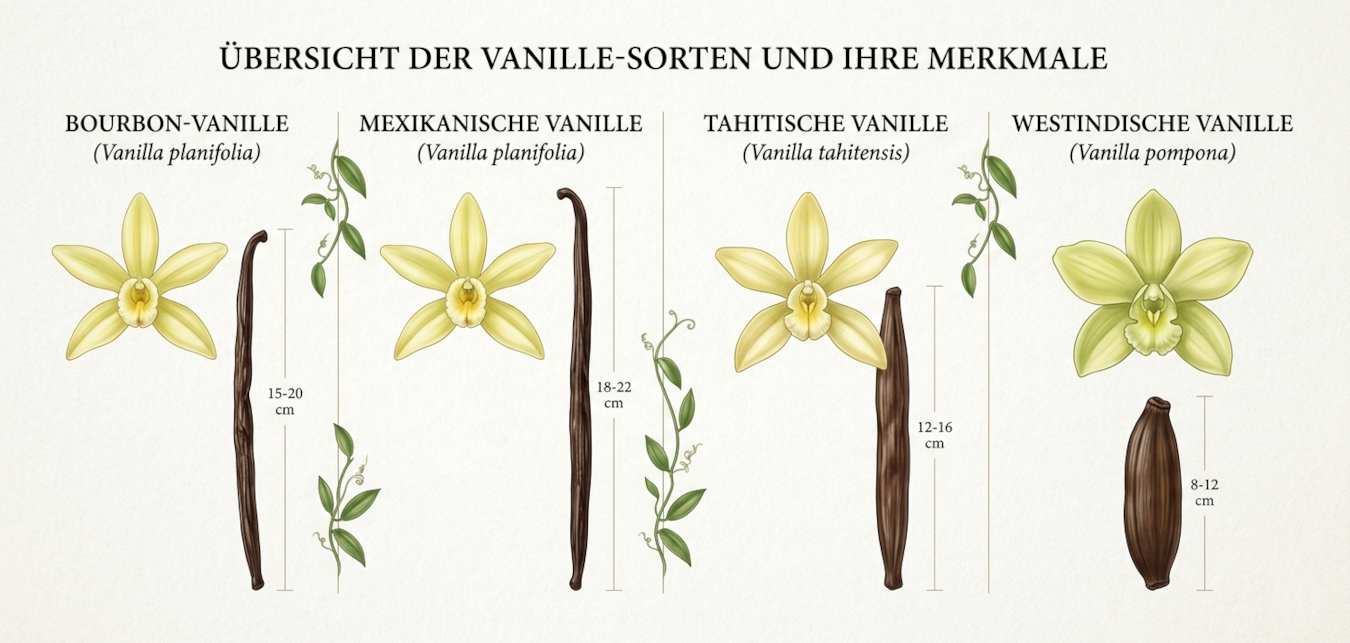
In response to the global vanilla shortage and the dominance of Bourbon vanilla (Vanilla planifolia), the tonka bean (Dipteryx odorata) established itself as an alternative years ago.
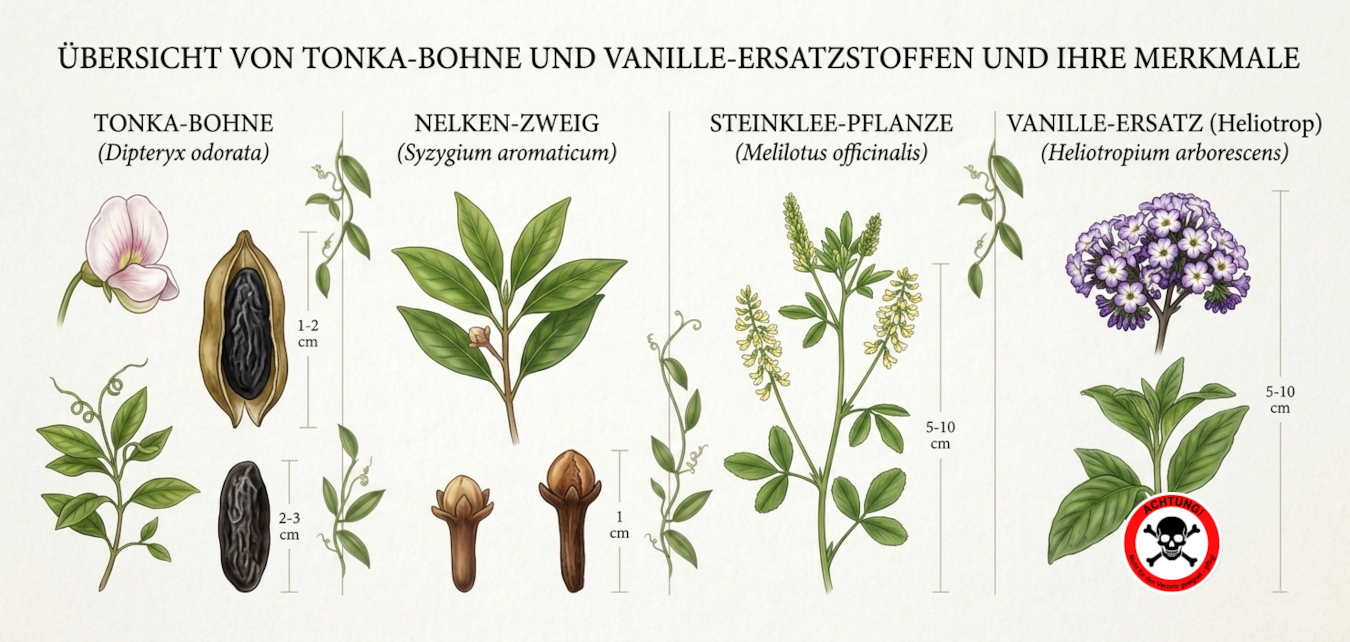
For this “production,” we agreed on two base flavourings, which are then each infused with the same terpenes in the same amount. This will make it easier later to compare the line with Tahitian vanilla against the tonka bean variant.

The Tonka Bean: The Mystical Wonder of Flavours
• Origin & Botany: The tonka bean tree belongs to the legume family (Fabaceae) and is native to northern South America, particularly the Amazon basin (Venezuela, Guyana, Brazil).
• The Journey to Europe (c. 1780): Toward the end of the 18th century, the bean was brought to Europe by French botanists.
• A Flavour Chemistry Milestone (1868): British chemist William Henry Perkin successfully isolated and synthesized coumarin from the bean for the first time. This marked the world’s very first artificial synthesis of an organic flavour compound, laying the structural foundation for the modern perfume and fragrance industry.
• Primary Modern Cultivation: Alongside traditional South American producers (Brazil, Venezuela), West Africa—particularly Nigeria—has evolved into one of the world’s largest exporters of the bean.
• Dominant Notes: Intensive vanilla, creamy marzipan, and sweet almond aroma.
• Subtle Undertones: Freshly mown hay (highly characteristic of coumarin), spicy clove, caramel, and distinct nuances of woody tobacco.
• Proper Culinary Use: Tonka beans are exceptionally hard. In the kitchen, they are grated directly into dishes using a fine grater (such as a Microplane), much like nutmeg. Alternatively, the whole bean can be simmered in milk or cream for desserts; it can then be washed, dried, and reused up to four times.
• The Coumarin Dilemma (Legal Status): Due to its incredibly high natural coumarin content (typically 1 to 3%, and up to 10% in premium specimens), the sale of the bean as a foodstuff was entirely banned in Germany in 1981. Since 2006, its use has been fully legalized under strict European Flavour Regulations, provided the maximum limits in the ready-to-consume end product (e.g., 5 mg/kg for desserts) are maintained.
• Visual Quality Check: High-quality tonka beans are deep black and heavily wrinkled. A fine, white crystalline coating on the surface is not mold; it is actually crystallized coumarin—a definitive hallmark of excellent quality!
Though it caused quite a stir historically and legally, the tonka bean remains one of the most elegant botanical treasures for multi-layered aroma layering in modern dessert design.
• W. H. Perkin (Chemical Society Journal) – The Synthesis of Coumarin, the Odoriferous Principle of the Tonka Bean (1868). Historical proof marking the birth of synthetic flavour chemistry.
• Federal Institute for Risk Assessment (BfR) – Toxicological evaluation of coumarin in foodstuffs (Opinion No. 043/2006 and updates). Regulates safe culinary dosing and defines the TDI (Tolerable Daily Intake) at 0.1 mg/kg of body weight.
• European Union / Flavour Regulation – Regulation (EC) No 1334/2008 (Annex III). Establishes legally binding maximum limits for coumarin in commercial foodstuffs and gastronomy.
• H. Panda (National Institute of Industrial Research) – The Complete Technology Book on Herbal Perfumes & Cosmetics. Documents the botanical distribution, harvesting practices, and chemical composition of Dipteryx odorata.
The Clove: The Molecular Double of Vanilla
• The Botanical Fact: Flat-leaved vanilla (Vanilla planifolia) is a highly sensitive orchid species. The clove (Syzygium aromaticum), on the other hand, is the dried flower bud of a tree belonging to the myrtle family (Myrtaceae).
• The Molecular Link: Clove oil consists of 80 to 95% of the phenol eugenol. Through targeted isomerization and oxidation, this molecule can be converted into identical vanillin—the primary flavour component of vanilla.
• Industrial Revolution: Following initial syntheses from pine bark (coniferin), German chemists Ferdinand Tiemann and Karl Reimer succeeded in the late 19th century in bringing the industrial extraction process of vanillin from clove-oil eugenol to market readiness.
• The Raw Material Pioneer: Before the more cost-effective production from lignin (wood waste) in the 1930s and later petrochemical guaiacol took over, the clove remained the world’s most vital source of artificial vanilla flavour for decades.
• For Desserts: A tiny hint of clove in a classic vanilla dessert breaks the sensory monotony and lends the dish an unexpected, profound dimension.
• For Savory Dishes: A subtle nuance of vanilla in clove-spiced braised dishes balances out harsh bitter notes and harmoniously rounds off the overall aroma profile.
The chemical bridge between cloves and vanilla proves that high-end gastronomy can elevate taste profiles to a three-dimensional level by utilizing smart, science-based aroma layering.
• Wikipedia – Vanillin: Synthetic History and Technical Syntheses (Standard Documentation on Flavour Chemistry).
• University of Bayreuth (Department of Chemistry Education) – Flavouring substances and vanillin: Biosynthetic reaction processes and biotechnology of eugenol.
• Symrise History – The renewable roots of synthetic vanillin (Tiemann, Reimer & Haarmann, Holzminden).
Yellow sweet clover: A “woodruff-vanilla” from the wild herb cuisine
The biochemical phenomenon: The fresh, undamaged plant is virtually odorless. Only when the cellular structures are broken down by wilting, freezing, or drying do the plant’s own enzymes (glycosidases) cleave the bound coumarin from the sugar molecules, releasing the characteristic aroma in its full intensity.
• Pastry & Desserts: Excellently suited for infusing milk, cream, or plant-based alternatives. It lends a floral, profound dimension to ice cream, panna cotta, parfaits, or crème brûlée.
• Liquid Culinary Arts: Perfect for extraction in aromatic syrups, summer lemonades, liqueurs, or as a botanical additive in modern craft beers.
• Scientific Food Pairing: Due to its molecular structure, sweet clover harmonizes excellently with stone fruits (peach, cherry), companionably tart rhubarb, as well as white and dark chocolate. Culinary boundary-pushers will find an exciting taste profile in combination with mature goat cheese.
• Dosage: In small quantities, coumarin is an outstanding flavour carrier. However, overdoses can trigger acute headaches and dizziness. The European Food Safety Authority (EFSA) defines a tolerable daily intake (TDI) of 0.1 mg coumarin per kg of body weight.
• Harvesting & Air-Drying: It is mandatory that sweet clover is dried absolutely flawlessly in the shade or frozen directly while fresh. In the event of damp spoilage or mold formation during the drying process, microorganisms (Aspergillus species) ferment the harmless coumarin into the highly toxic, anticoagulant dicoumarol.
Processed in a culinarily clean and mindful manner, yellow sweet clover is a highly elegant, regional flavour provider that effortlessly replaces synthetic aromas.
• European Pharmacopoeia (Ph. Eur.) – Monograph: Meliloti herba (Sweet clover herba). Defines the purity criteria and the coumarin-bound mechanism of action of the plant.
• National Center for Biotechnology Information (NCBI / PubChem) – Documentation on the enzymatic cleavage of coumarin glycosides upon plant injury/drying.
• Federal Institute for Risk Assessment (BfR) – “New findings on coumarin in cinnamon, woodruff, and sweet clover” (Opinion No. 043/2006 incl. toxicological updates).
• Stahmann, M. A. et al. (Journal of Biological Chemistry) – “Studies on the haemorrhagic sweet clover disease.” Primary scientific source on the formation of dicoumarol during the spoilage of Melilotus.
Heliotrope (Cherry Pie Plant): The Forbidden Fragrance Inspiration
Just one year after coumarin was isolated from the tonka bean, chemists discovered the aroma compound piperonal (also known as heliotropin) within the blossoms of the heliotrope in 1869. This molecule took the perfume industry by storm and formed the chemical backbone for world-famous, sweet-powdery fragrance classics such as L’Heure Bleue by Guerlain.
Heliotrope contains high concentrations of pyrrolizidine alkaloids (PAs). These secondary plant metabolites are highly liver-toxic (hepatotoxic) and can cause chronic liver damage (such as veno-occlusive disease) if ingested. Furthermore, they have been shown to be mutagenic and carcinogenic in animal studies.
• In Industry (Synthetic): The isolated or synthetically manufactured heliotropin molecule is strictly regulated and utilized in perfumery as well as for scenting cosmetics, soaps, and fine baked goods.
• In the Garden and on the Terrace: Here, the plant remains irreplaceable as a natural, mesmerizing fragrance provider and a magnet for butterflies and bees.
• As Culinary Inspiration: Heliotrope serves chefs and pastry artists purely as an “olfactory compass.” If we want to replicate the scent of heliotrope in a dessert (e.g., a cream or an ice cream) in a natural, completely safe way, we utilize a clever combination of genuine vanilla, tonka bean, and a dash of bitter almond oil.
Heliotrope impressively demonstrates that nature can create fantastic aromas meant to be deeply inhaled through the nose, but never picked up with a fork!
• Fittig, R. & Mielck, W. (1869). Untersuchungen über die Constitution des Piperonals und seiner Derivate. Annalen der Chemie.
• Federal Institute for Risk Assessment (BfR) – Analysis and toxicity of pyrrolizidine alkaloids in food and feed.
• European Food Safety Authority (EFSA) – Risk assessment of pyrrolizidine alkaloids in food.
The Choice of Terpenes
When Christmas & Easter fall on the same day – it felt almost like that when Ben from the Humboldt Seed Company handed me the small, inconspicuous bottle of BlueBerry Muffin.
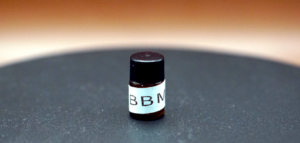
Essentially, you cannot buy something like this – it comes from Ben Lind‘s “secret garden,” from his “private edition” of stringently organically grown top strains.
The BBM terpenes were also extracted organically & very gently to preserve the terpenes – the quality blows you away – essentially almost more overwhelming than blueberries themselves – but without seeming artificial in the slightest – which is quite astonishing given such a high concentration and quality.
Thank you so much, Ben! Naturally, the BBM terpene is a MUST and therefore a given for use in our terpene jams – and the only candidate here that was authentically extracted from cannabis.
The next choice fell on two terpenes from CALI Terpenes – BlackBerry Kush & Sweet Tooth. Both are entirely unique terpene fingerprints that CALI has recreated using botanical terpenes, meaning those not extracted from cannabis.
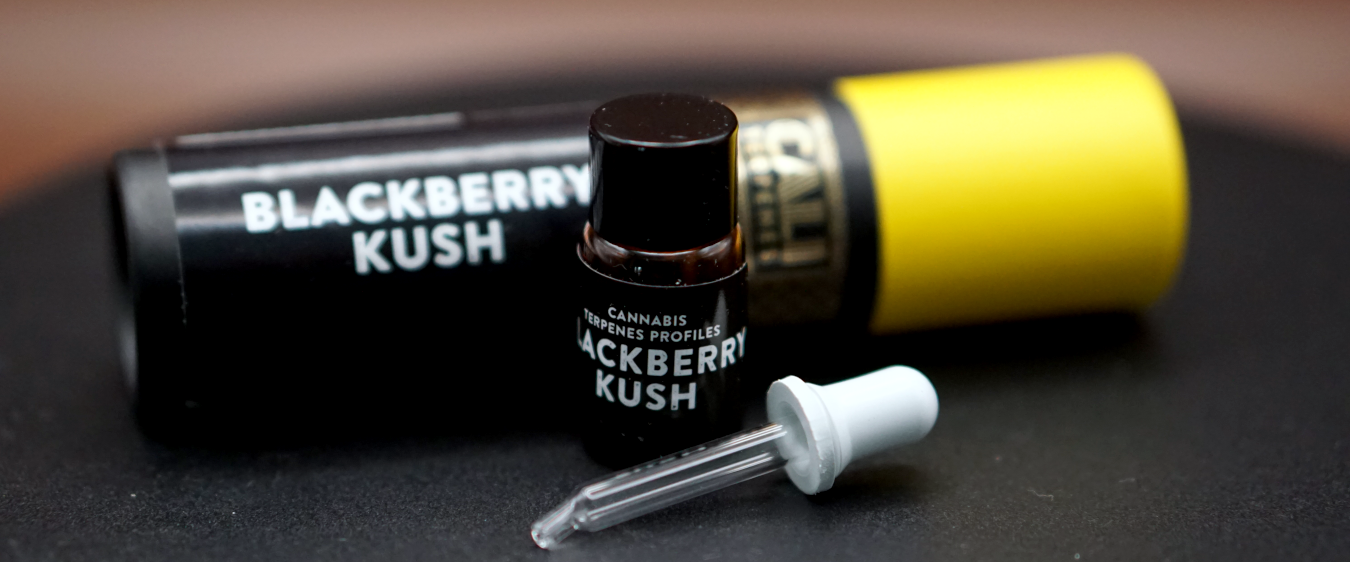
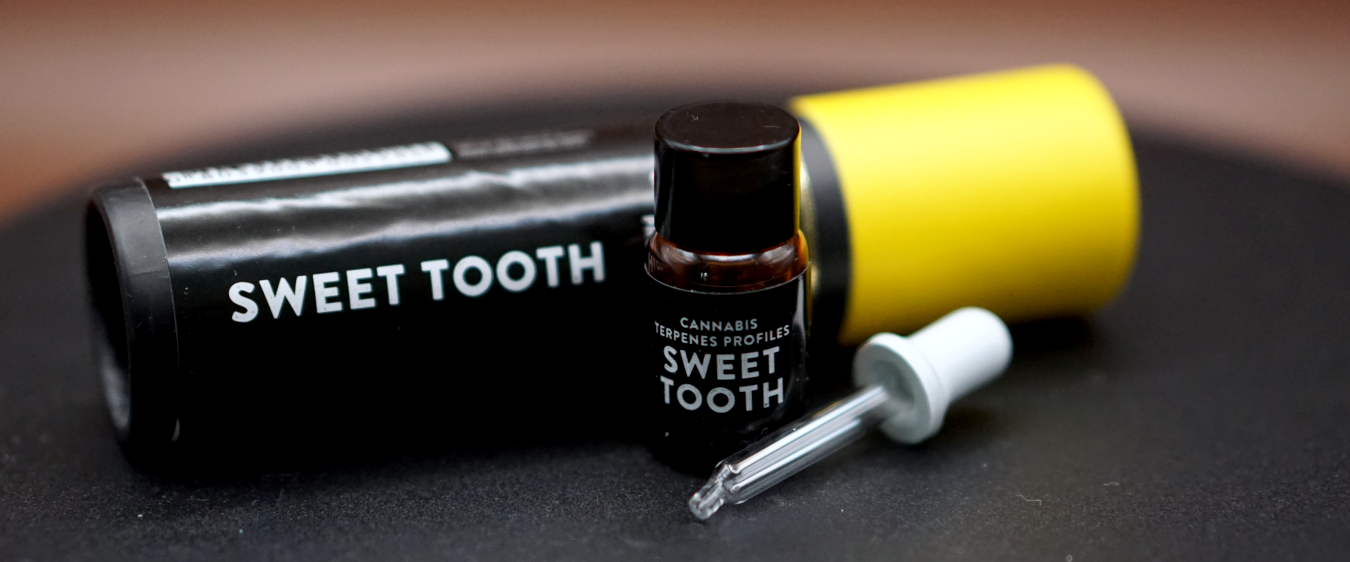
Through this approach, a terpene producer saves a lot of administrative effort; the quantities extracted from other “plants” are larger, and production is cheaper. The always spot-on composition over the years is also made possible this way. Certainly important factors for industrial ventures.
The inclined star chef or connoisseur, on the other hand, certainly sees this differently, because all the little nooks where unexplored terpenes, phenols, and other compounds hide – meaning everything that constitutes the “body,” just like with a wine – are simply no longer truly together.
Therefore, it would definitely be a plan to breed a completely unique strain that lends itself perfectly to a specific event – limited, so to speak. After that, it shouldn’t be available anymore, something highly exquisite that can be made possible not necessarily with a lot of money, but rather with a lot of time.
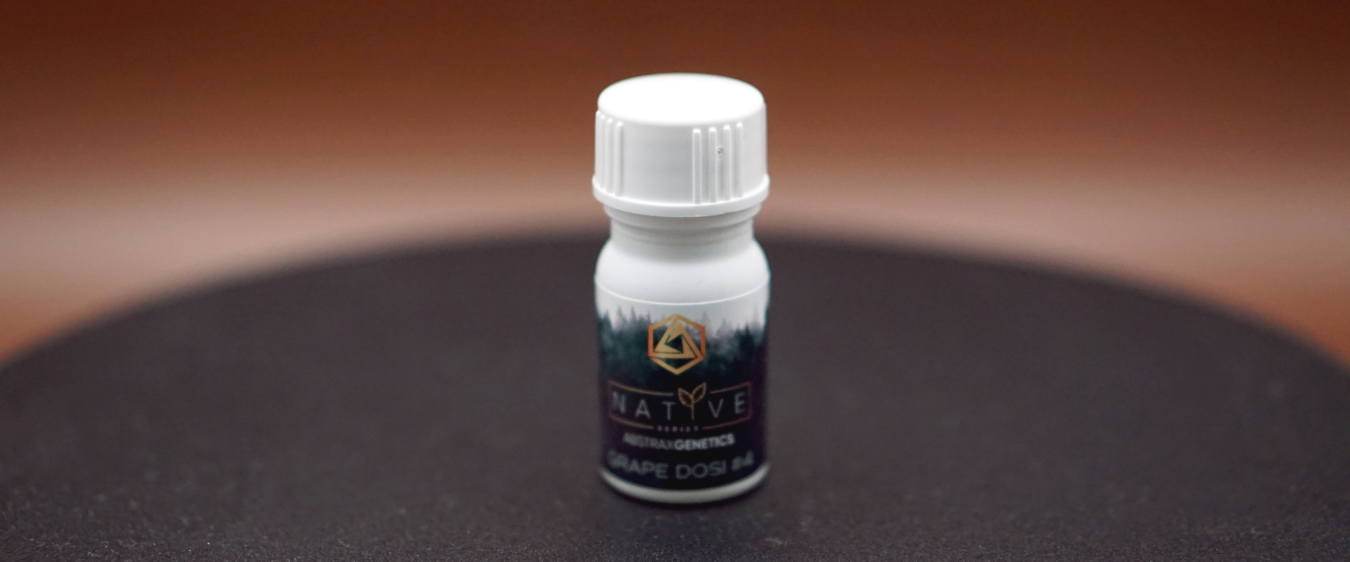
Then there were the truly noteworthy terpenes from Abstrax Tech: Grape DOSI #4 & Orange Apricot. Both terpenes were absolutely convincing, whereby Orange Apricot certainly pairs exceptionally well with plums.

The Citral used comes from Herrlan – unfortunately, no interaction was possible with this company, not even in a customer context, which is a pity, but this “terpene blend” can be found with any manufacturer worth their salt.
Regarding Citral, I included an info box “Excursus: The Secret of Citral” in the post “Why Terpenes Are Relevant Now,” which also deals with olfactory memories. Furthermore, information on the various terpene producers and terpene properties, such as dosages & application examples, can be found there and in the other posts.
So we need
- 1kg grapes or of your choice
- 500g 2:1 preserving sugar (If you prefer it less sweet, go for 3:1)
- 3 pods of Tahitian vanilla
- 1 tonka bean (freshly grated)
- 1 pinch of Inca sun salt
- The terpene of our/your choice
- …and plenty of jars
So you set your fruits with the sugar, tonka bean, and/or vanilla – don’t forget the obligatory pinch of salt – and then prepare your jars. Once these are ready, the heating & boiling of the mixture can begin. First, however, we take care of the terpenes.
Dilution patterns – a first approach

When we cooked the jams, we didn’t really have a concept for the dosage yet; after all, we wanted to flavour a jam that was still hot. This in itself is difficult, since terpenes poorly “endure” temperatures beyond 30°C and evaporate – some even significantly earlier.
So the question arose as to whether a certain overdosage might be necessary in order to encapsulate exactly the right proportion of terpenes at the moment of sealing.

In the first stage of dilution, we put 0.3ml – 0.5ml of terpenes into 20ml of water; I say “put” because terpenes predominantly “float” since they are hydrophobic (water-repellent) and simultaneously lipophilic (fat-loving).
Since pure terpenes cannot be mixed with water without using auxiliary substances, vigorous shaking right before application was sufficient for us here to create a short-lived emulsion.
The second stage of dilution is the part where the terpenes meet the food to be flavoured. Here, it is crucial what quantity you want to flavour. Added to this are aspects like – does the food have fat content and how high is it, is the fat evenly distributed, or does the dish possibly have a flaky texture. Quite a few factors can play a role here, which is why “trial and error” is the best approach.
Our challenges were, on the one hand, the fact that our jam would hardly have a significant fat content – and on the other hand, the temperatures that needed to be maintained so that, for example, Weck jars (we also experimented with various other models) seal properly vs. the “flight instinct” of the terpenes.
Ultimately, we made the final dosages dependent on the jar sizes and consciously planned for some variance.
Jams, dosage in ml/g based on the capacity of the jars
- 75g to 100g – 0.3ml to 0.5ml diluted terpenes
- 200g to 250g – 0.5ml to 0.7ml diluted terpenes
- 350g to 400g – 0.8ml to 1.4ml diluted terpenes
What is very important – time works for us. Why? It has been found with honey, for example, that it is better to leave it “in peace” for a while after flavouring; meaning the full power of the terpenes is only fully unlocked in the jar within the food to be flavoured – at least with certain consistencies and ingredients.
What works for honey should also apply to a sweet jam. For Mary Jane 2026, I would bring a few little jars with me to Berlin – if somone of you provided a suitable event, a breakfast, or brunch offer from June 11th – 14th for a tasting in the “Muddastadt” to provide the proof…;-)

Take care, and as always, have fun “cooking it yourself”.