
Terpenes in the iSi Thermo Whip – Carrying Aroma with Precision Instead of Letting It Vanish
Terpenes are volatile, highly potent, and sensorially mercilessly honest. Anyone wishing to utilize them in the iSi Thermo Whip is not entering a playground, but rather working at the intersection of flavor chemistry, lipid binding, and temperature control. It is precisely here that it is decided whether a foam carries elegantly – or whether precious aromas simply disappear.
The most common mistake lies in the initial approach: Terpenes are not foaming agents, but pure aromatic components. The Thermo Whip amplifies their effect but forgives no structural weaknesses. Everything therefore begins with choosing the right carrier medium.
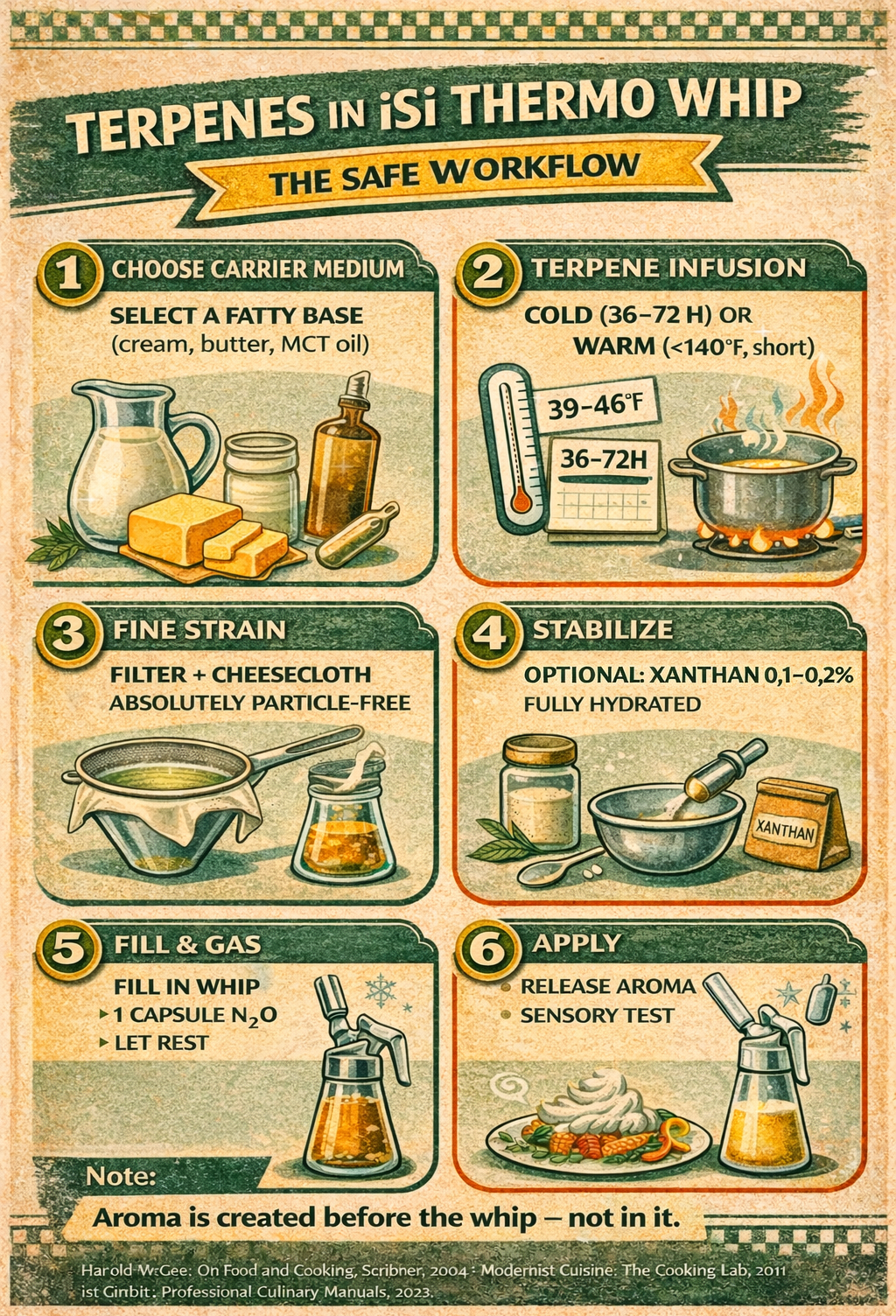
Fat is the natural ally of terpenes. The lipophilic structure of many terpenes ensures that they not only dissolve better in fat, but also remain significantly more stable there. Cream, butter, crême fraîche, or modern fat carriers such as MCT oil form a protective matrix that binds the aroma and releases it evenly. Water-based systems, on the other hand, allow terpenes to escape quickly – the resulting foam then feels flat, short-lived, and aromatically unbalanced (McGee, 2004, p. 267).
The second critical factor is temperature. Terpenes are highly sensitive to heat, with many evaporating well below 100 °C. In practice, this means: Infusion yes – boiling no. Two methods have proven effective.
Cold fat infusion, where terpenes are integrated into a fat medium over several hours or days at refrigerator temperature, delivers maximum aromatic fidelity and sensory depth. Alternatively, a warm brief infusion can be used, but strictly below 60 °C and with immediate straining to prevent bitter compounds and aroma loss (Modernist Cuisine, 2011).
The infusion is followed by the most important, often underestimated step: straining (passing). Terpenes themselves are liquid or gaseous, but any infusion potentially introduces micro-particles. These must be completely removed. A fine sieve alone is not sufficient; a cheesecloth or etamine is mandatory. The Thermo Whip forgives no particles – neither technically nor sensorially.
Only after this step is stabilization carried out. For terpene-based applications, a moderate fat base is usually sufficient; additional binders should be used sparingly. Xanthan gum in very low dosages (0.1–0.2%) can help homogenize aroma distribution without altering the mouthfeel. It is crucial that hydrocolloids are fully hydrated before the mixture enters the Whip (iSi, 2023).
The dosing of the terpenes themselves is not done mathematically, but sensorially. Drop by drop, always while tasting, always with respect for the intensity. Terpenes are not spices, but highly concentrated aroma carriers. Here, less is almost always more.
When properly executed, foams are created that are not loud, but precise: clearly defined citrus notes, floral accents, earthy depth – carried by fat, stabilized by structure, released at the perfect moment. The Thermo Whip thus becomes not an effects gadget, but a tool for controlled aromatics.
Conclusion
Terpenes in the Thermo Whip only function reliably when treated as what they are: volatile aromatic compounds with clear physical requirements. Lipid binding, low temperatures, absolute filtration, and restrained dosing are not options, but prerequisites.
Key Rule
Aroma is created before the Whip – not inside it.
SOURCES
- Harold McGee: On Food and Cooking, Scribner, 2004
- Modernist Cuisine: The Cooking Lab, 2011
- iSi GmbH: Professional Culinary Manuals, 2023
Copyright and Editorial Responsibility
AI-supported systems were used during the research for this article, including OpenAI ChatGPT, Google Gemini, and Anthropic Claude. AI was used exclusively as an aid. The selection, evaluation, editorial classification, structuring, and formulation, as well as the review of content and compliance with journalistic due diligence and copyright requirements, were and remain the responsibility of the publisher.
All articles and interviews remain the property of the author. Use or reproduction is permitted only with express permission. Opinions expressed are those of the author. Errors excepted.
Disclaimer: The information presented in this article is intended solely for educational and entertainment purposes. Culinary use of terpenes should always comply with applicable local laws.