



Alexander Daske, Pharmacist & Consultant – has been working in the medical cannabis sector since 2019 and has been able to gain experience along the entire pharmaceutical supply chain – from working as a laboratory manager in a pharmacy to his current role as the owner of the Christophorus Apotheke in Mannheim.
Together with our team, he supplies cannabis patients throughout Germany and places special emphasis on intensive pharmaceutical counseling for this complex form of therapy. In addition, the Christophorus Apotheke develops its own product innovations, especially for patients in the field of pain management.

From Pharmacist to Cannabis Specialist
[Erik]: Hello Alex, it’s great that despite the hustle and bustle of Mary Jane, you found the time for our terpene interview. As I mentioned beforehand, the focus at foodadvisor is on the culinary aspects of life. That doesn’t mean, however, that our readers wouldn’t like to learn a little about you first.
How did you get into the medical cannabis business, and where did you first come into contact with the topic?
[Alex]: Hello Erik. Well, first of all, I am a traditionally trained pharmacist.
Before deciding to pursue a career as a pharmaceutical consultant in the medical cannabis sector, I worked in a pharmacy specializing in cannabis. That’s where I first got hands-on experience with the topic.

[Erik]: How long have you been active in the industry altogether?
[Alex]: I’ve now been working in the medical cannabis sector for six years. Naturally, I also enjoy contributing as an expert in product innovation and helping to develop optimized products.
[Erik]: What does that actually look like? Do you spend your days sitting in pharmacy laboratories contemplating innovative ideas?
[Alex]: Yes, that’s certainly part of it. As an external consultant, I work with a handful of companies operating within the medical cannabis industry.
[Erik]: Okay, that sounds both extensive and fascinating.
The topic I’ve chosen today is flavoring foods and beverages using cannabis terpene profiles. My interest stems from the fact that there are hardly any flavors left that truly surprise people. Whether it’s tonka bean, Bourbon vanilla, or various fruit varieties—most flavors have already been experienced countless times.

Terpenes: A New Dimension in Culinary Arts
[Alex]: Yes, flavours and terpenes have their own seasons as well.
[Erik]: Many cannabis terpene profiles have already been extensively researched and documented. This allows the use of highly complex flavor profiles that may include notes of pineapple, mango, lime, or pine, yet still leave guests wondering what exactly they are tasting—without necessarily producing any intoxicating effects.
[Alex]: Absolutely. There is already excellent documentation available on the terpene profiles of a wide variety of strains.
[Erik]: Different businesses naturally have different requirements when it comes to terpenes. A soft drink manufacturer, for example, wants to ensure that its flagship beverage tastes exactly the same for years to come. In that case, it isn’t crucial that the entire “body”—to borrow a term from wine—is preserved. If a few phenolic compounds are missing, that’s not a major issue. Consistency is what matters most.
[Alex]: Which certainly makes sense for production processes designed to run consistently over many years.

[Erik]: A Michelin-starred chef, on the other hand, might go so far as to extract a limited quantity of terpenes from a particularly rare strain specifically for a season, a week, or even a single dish. In that scenario, unlike industrial production, the goal is to preserve and enjoy the entire aromatic body, including all its nuances and imperfections.
[Alex]: I’m sure there is an audience for that as well, even if it’s considerably smaller than the market for soft drinks.
[Erik]: When did you consciously notice terpenes for the first time in your life? Are there any terpene-driven foods or beverages that you particularly remember?
[Alex]: I encounter aromas and terpenes every day through my work in the pharmacy. Unfortunately, I frequently observe that many cannabis flowers are too dry and are not stored properly. That’s why, when selecting cultivars for patients, I pay particular attention to residual moisture content and aroma freshness.
Out of the more than 2,000 listed medical cannabis flower products currently available, only a handful remain truly convincing when judged according to these quality criteria.

Cannabis Terpenes: Between Nature and Reproduction
[Erik]: Given your background and years of experience, do you believe that flavoring foods and beverages with cannabis-derived—or recreated—terpene profiles is an emerging trend?
[Alex]: Yes, but I believe the focus should primarily be on working with cannabis-derived terpenes and using them only in meaningful, natural concentrations of no more than approximately 5%.
Personally, I would avoid working with artificial or purely botanical terpenes, as they may potentially cause irritation.
[Erik]: Alex, you undoubtedly come across strains whose terpene diversity is astonishingly complex—far more complex than the flavor profiles found in most kitchens around the world. Conventional flavors such as Bourbon vanilla, rum, or green tea are no longer particularly surprising.
Some of the terpene samples I had the opportunity to experience here at the trade show were so intensely aromatic—yet never overpowering—that they would undoubtedly lend themselves to sophisticated perfume creations as well.
[Alex]: There is certainly no shortage of that here. What’s important to understand is that terpenes are only one part of the equation. Other aromatic compounds, such as thiols and flavonoids, also contribute significantly to the overall aroma profile.
In general, there are both stimulating and more calming terpenes. Ultimately, the key is finding the right cultivar for the respective patient.
[Erik]: How does business currently work for your clients? How should people imagine the process?
[Alex]: At the moment, the business model is largely based on bringing cultivars from around the world into Germany, representing different producers, and introducing these producers to the German market.
Green Karat, for example, would be a facility operating out of Canada.
These companies bring their most exclusive cultivars to Germany, where they are refined and subsequently introduced into the market as medical cannabis products.
[Erik]: So at present, you’re primarily refining cannabis flowers intended for pharmaceutical prescription use and are not yet producing extracts or isolating terpene profiles on a larger scale?
[Alex]: Correct.

THCA, Decarboxylation, and Extracts: Explained Simply
[Erik]: Well, what isn’t happening yet may still happen in the future. We’ll see.
While preparing for the trade show, I read a report about THC that left me somewhat confused. It claimed that cannabis plants do not actually contain THC, but rather THCA, which is said not to be intoxicating. Is that correct?
[Alex]: Exactly. In the plant itself, cannabinoids primarily exist in their acidic form—specifically THCA, or tetrahydrocannabinolic acid.
This compound first needs to be activated. That activation occurs either to a limited extent through enzymatic processes within the body or, as is the case with traditional cannabis flower consumption, through the application of heat.
In other words, the material undergoes decarboxylation either during combustion or during vaporization, as commonly practiced in the medical sector.
[Erik]: With your background and experience over the last few years, let me ask you this: Do you believe that flavoring with cannabis-derived or reconstructed terpene profiles is an emerging trend?
[Alex]: Yes, but I see the primary focus on working with cannabis-derived terpenes whenever possible and only adding them in sensible, natural concentrations of no more than around 5%. Personally, I would not work with artificial or purely botanical terpenes, as they may potentially cause irritation.
[Erik]: Alex, you must encounter quite a few strains whose terpene diversity is extraordinarily complex—far more complex than the flavor profiles found in most kitchens around the world. Common aromas such as Bourbon vanilla, rum, or green tea no longer surprise anyone.
Some of the terpenes I had the chance to “sample by scent” here at the trade show smelled so intensely—yet without being overpowering—that they would certainly lend themselves to sophisticated perfume creations as well.
[Alex]: There is definitely a lot of that here. It’s important to remember that terpenes are only one part of the aromatic equation. Other compounds such as thiols and flavonoids also contribute significantly to the overall aroma profile. In general, some terpenes tend to be stimulating, while others are more calming. Ultimately, the key is finding the right cultivar for the individual patient.
[Erik]: How does business currently work for your clients? How should people imagine it?
[Alex]: At the moment, the business model is largely based on bringing cultivars from around the world to Germany, sourced from different producers, and then presenting these producers within the German market. Green Karat, for example, would be a Canadian facility operating in this space.
These companies bring their most exclusive cultivars to Germany, where they are refined and subsequently introduced to the market as medical cannabis products.
[Erik]: So, at the moment you’re primarily refining cannabis flower for pharmaceutical prescriptions and not yet producing extracts or isolating terpene profiles on a larger scale?
[Alex]: Correct.
[Erik]: Well, what isn’t happening yet may still happen in the future. We’ll see.
While preparing for the trade show, I came across a report about THC that confused me. It stated that cannabis plants do not actually contain THC, but rather THCA, which supposedly has no intoxicating effects. Is that accurate?
[Alex]: Exactly. In the plant, cannabinoids are primarily present in their acidic form—in this case THCA, or tetrahydrocannabinolic acid. This compound must first be activated. That activation occurs either enzymatically to a small degree within the body or, as is typically the case with cannabis flower, through heat.
In practical terms, this means the material undergoes decarboxylation either during combustion or during vaporization, which is the standard route in medical applications.
There are now some very interesting research approaches investigating the targeted use of acidic cannabinoids such as THCA, CBDA, and other cannabinoid acids for specific symptoms.
Through enzymatic processes associated with the first-pass effect, partial activation can also occur. Particularly sensitive patients may respond to these compounds. Additionally, other constituents—especially the full spectrum of aromatic compounds—play an important role.
[Erik]: That’s fascinating. So if someone ate fresh flowers or flavored food with live rosin, there would theoretically be no intoxicating effect? Over the decades, however, there have been recurring reports of both humans and animals becoming somewhat… let’s say, coordinatively impaired after consuming fresh cannabis.
But let’s return to decarboxylation. The correct temperatures must be crucial, right?
[Alex]: Absolutely. You need to consider the boiling points and activation ranges of the various cannabinoids, because their decarboxylation temperatures differ. THC is typically released efficiently at vaporization temperatures between approximately 315–356 °F, while CBD is released at around 338 °F; therefore, the vaporization process is optimal at temperatures between 356 °F and 410 °F to activate the cannabinoids.
Important: These figures do not represent the actual boiling points themselves but rather temperature ranges in which activation and vaporization occur during heating.
[Erik]: Okay, so that would describe the classic consumption method for flower. Is it different with extracts?
[Alex]: Extracts generally need to be decarboxylated beforehand, which is achieved through heat. Oils, oral extracts, and rosin can also exist in a non-decarboxylated state—for example when freshly pressed from trichomes separated via ice-water extraction.
Medical cannabis oils and most oral extracts are already activated or decarboxylated. Exceptions include certain live rosin and live resin products.

[Erik]: Or products made from fresh flowers?
[Alex]: Exactly. Fresh flowers can also be used through ice-water trichome separation. The collected trichomes are then pressed to produce live rosin. Naturally, this material will still contain THC if the original cultivar contains it.
[Erik]: As far as non-intoxicating varieties are concerned, there are some extremely interesting culinary strains available. That would make it possible to produce live rosin for flavoring purposes without any concerns about psychoactive effects.
[Alex]: Yes, there are many fascinating cultivars suitable for applications such as flavoring CBD edibles. The key requirement is that these strains consistently remain below 0.2% THC (subject to regulatory requirements based on the intended use and jurisdiction).
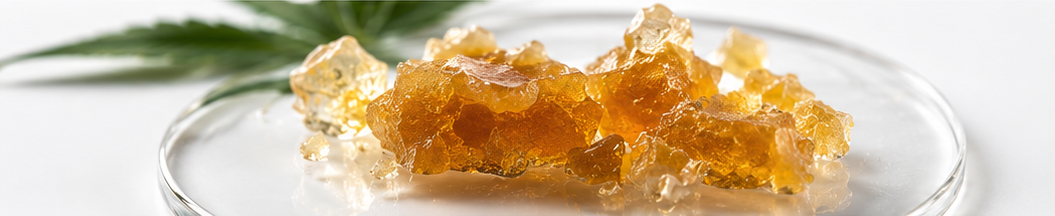
Rosin, crumble, and the quest for the perfect flavour
[Erik]: When it comes to flavoring, which base material appears most suitable to you—terpene solutions, crumble, rosin, fresh buds?
[Alex]: First, it must be clear whether psychoactive compounds such as THC and/or anti-inflammatory cannabinoids such as CBD or CBG are intended to be present. If the goal is non-intoxicating flavoring, then the terpenes and phenolic compounds must be extracted independently.
[Erik]: Depending on the extraction method, you also end up with different textures—for example, the granular texture of crumble.
[Alex]: Correct. Vacuum, temperature, and pressure all play critical roles. These parameters create the characteristic granular structure of crumble. The product primarily contains THCA, which is inactive until it is converted into THC through heat.
[Erik]: …and crumble is always in the THCA form.
[Alex]: Exactly. It only becomes decarboxylated through heat. In terms of flavoring applications, that’s an important distinction because some oxidation has already occurred during production, and a significant number of terpenes have been lost due to heat exposure.
[Erik]: That makes crumble somewhat less attractive for culinary applications—although still a pity considering the extract itself. The goal should always be to preserve as much of the original character as possible rather than destroying it at the finish line.
[Alex]: Personally, I am a huge fan of extracts and have been working with them intensively for about two years. When they’re produced properly, extracts are genuine terpene bombs.

The Entourage Effect and Culinary Applications
[Erik]: Do you think terpenes can generally influence mood, and could this potentially be utilized when seasoning food and beverages?
[Alex]: Absolutely. If you inhale fresh aromas such as citrus, pine, conifer-like scents, or orange notes, they can definitely have an awakening and stimulating effect. Apple aromas would be another example.
[Erik]: That aligns perfectly with the direction of my concept. Beyond opening up a whole new world of flavors, it could also add a genuine soul-food component.
[Alex]: Certainly—but the combinations would need to be carefully researched.
[Erik]: I definitely need to visit Humboldt Seeds in the United States. Beyond the spirit surrounding the company, I’m fascinated by the sheer diversity of genetics there. Terpenes seem to be at the center of breeding new strains right from the design stage.
[Alex]: Yes, Humboldt really has some fantastic strains. What’s important to remember, however, is that every plant—indeed every flower—has its own unique genetic as well as chemical fingerprint.
[Erik]: Which means the terpene expression also depends on the phenotype, correct?
[Alex]: Exactly. If you have the same genetic lineage expressed through two different phenotypes, you’ll end up with different terpene profiles. That’s what makes the subject so fascinating to me.
Cannabis-Derived vs. Botanical Terpenes
[Erik]: From your perspective, what speaks in favor of using cannabis-derived terpenes as flavoring agents compared to terpenes sourced from oranges, tomatoes, pine trees, or other plants?
[Alex]: Personally, I’m a big advocate of using cannabis derivatives. Terpenes isolated directly from the cannabis plant are truly plant-identical to that specific plant, rather than being sourced botanically from unrelated species.
[Erik]: Fair enough. After all, the goal is always to achieve the highest possible quality.
[Alex]: Exactly. This approach allows you to capture the complete terpene and phenol profile of a specific strain—or even an individual plant—within your extract.
[Erik]: I agree. However, terpene specialists such as CALI Terpenes have also provided some compelling arguments in favor of reconstructing terpene profiles. Ultimately, I think the intended application is what matters most.
[Alex]: Botanical terpenes are widely used because the raw materials are more affordable and easier to obtain. Nevertheless, I remain a strong supporter of cannabis-isolated terpenes. Chemically speaking, the compounds are nearly identical.
[Erik]: Chemically perhaps, but from the limited comparisons I’ve conducted myself, I often felt I could quickly tell which profiles were native and which had been reconstructed.
[Alex]: The molecular structures of the individual terpenes are indeed identical. However, I personally perceive a difference as well. Cannabis-derived terpenes offer a more intense yet natural flavor profile and tend to exhibit a more balanced concentration.
[Erik]: From a culinary standpoint, reconstructed profiles often feel somewhat less complete because certain gaps remain unfilled. The most authentic flavor experience only emerges through the interaction of all individual compounds. If some components are missing, even effects such as mood enhancement may be diminished.
[Alex]: Exactly. This becomes especially apparent when discussing the entourage effect and the interaction between terpenes, THC, and CBD. If you’re able to successfully isolate the essence of a strain and incorporate it into specialized drinkables or edibles, the result can be truly exceptional.
[Erik]: That certainly sounds promising for future product innovations.
[Alex]: The full-spectrum effect is crucial. It’s very similar to cooking: dishes only become truly harmonious when the highest-quality ingredients are used. The same principle applies here.
Quality, Storage, and the Loss of Sensitive Terpenes
[Erik]: Speaking of quality, what impact do factors such as time, heat, and transportation have on these valuable terpenes?
[Alex]: Degradation and oxidation begin as soon as the optimal harvest window is missed. Some monoterpenes are highly volatile even at room temperature and can gradually degrade if stored or processed improperly, even at temperatures as low as 63°F (which is below room temperature).
[Erik]: That obviously requires considerable effort and technical expertise.
[Alex]: Absolutely. It’s essential to keep degradation processes as brief and gentle as possible. Success largely depends on maintaining mild temperatures, proper humidity levels, and sufficient airflow.
During cultivation—particularly toward the end of the flowering phase—I frequently encounter flowers that have already lost a significant portion of their terpene content. Many are grown under very high temperatures, for example in Portugal, and subsequently processed under similar conditions. As a result, a substantial amount of terpene content is lost before the product even reaches the consumer.
[Erik]: I always assumed cannabis plants naturally tolerate higher temperatures quite well.
[Alex]: Generally speaking, they do. However, temperature eventually destroys terpenes. There’s another misconception as well: if a flower smells overwhelmingly strong before being broken apart, that’s often not a sign of superior quality. A clean, well-cured flower should only release its full aroma once it’s ground or crushed.
[Erik]: That aligns with some of the things I’ve heard from terpene producers. Since terpenes are now readily available, lower-quality cannabis is often sprayed with terpene solutions and marketed as a premium product without any disclosure.
[Alex]: Exactly. Unfortunately, that does happen, and it’s one of the less appealing aspects of the industry.
To summarize: if you want to capture the full character of a cannabis terpene profile through extraction, every step must be handled gently. Drying, trimming, transportation, temperature management, humidity control—all of these factors must be optimized, especially during the flowering phase.
[Erik]: Unfortunately, the fast-paced nature of today’s market probably works against that level of care in many cases.
[Alex]: At the moment, much of the market remains focused almost exclusively on THC and CBD percentages. The dominant questions tend to be: “How easy is this cultivar to grow?” and “How quickly can it be harvested?”
For me, however, the equation is simple: the more quality you invest into cultivation, the more terpenes and phenols you preserve within the plant and its flowers. The result is a broader and ultimately higher-quality spectrum of compounds.
[Erik]: …and ultimately that’s exactly the level of quality we need in the culinary pantry and flavor library of the future.
[Alex]: Aromas are what truly define cannabis. They’re what allow you to distinguish one cultivar from another. You can’t do that based on THC levels alone, nor by relying on the often imaginative strain names.
[Erik]: That’s certainly true. The creativity behind strain names is sometimes astonishing. The number of Blueberry and Pineapple variations I’ve seen here at the show alone is incredible.
For culinary applications, however, those names remain indispensable because they at least provide some indication of the underlying flavor direction. There is tremendous potential for surprises, of course—but the terpene-profile-based cookbook for everyone from hobby cooks to molecular gastronomy chefs is still waiting to be written… 😉
[Alex]: I look forward to it. Feel free to reserve a copy for me.

The Terpene Compass for the Kitchen and Gastronomy
[Erik]: While researching the topic, I started wondering whether a terpene cooking system could be developed similarly to how complementary colors are used in design.
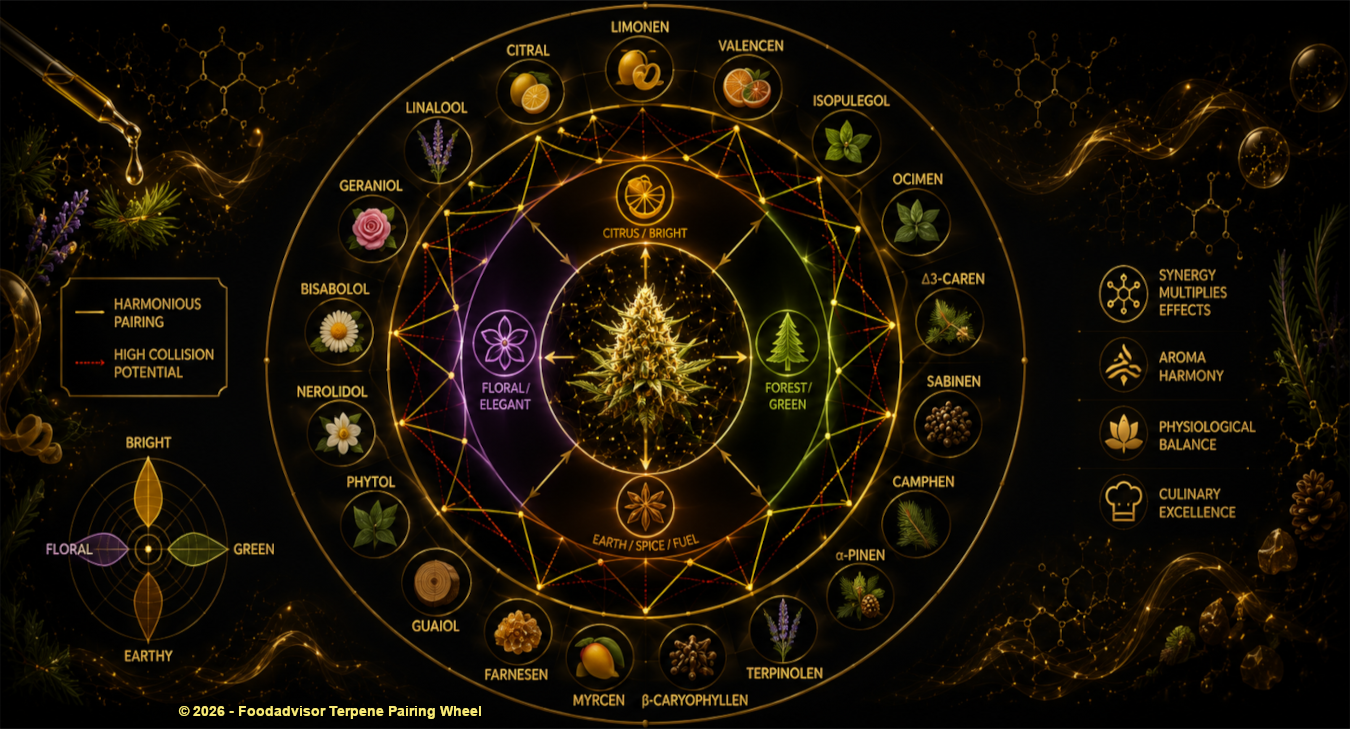
Imagine a circular chart where the most important and best-researched terpenes are arranged around the perimeter. Opposing terpenes could represent complementary characteristics, while interactions and synergies could be visualized as relationships within the diagram.
[Alex]: There are already studies moving in that direction. For example, one analysis examined approximately 140 strains. Citral was identified in 38 of them, while major terpenes such as beta-caryophyllene and limonene were quantified both in concentration and ratio.
Based on these findings, the medical cannabis flowers were categorized into six distinct clusters and statistically documented according to their terpene profiles.
You could certainly derive valuable insights from that kind of data for culinary applications—even without any psychoactive effects.
[Erik]: That sounds incredibly interesting. Personally, I believe that if chefs—particularly ambitious fine-dining chefs—were provided with a visual tool that was intuitive yet scientifically meaningful, similar to the complementary-color concept we discussed, it could become a genuine gateway for introducing terpenes into modern cuisine.
[Alex]: Yes, I can absolutely see that working.
The Influence of Genetics, Phenotype, and Cultivation Methods
[Erik]: Especially in culinary applications, consistency is crucial. Chefs need ingredients whose flavor and behavior remain as predictable as possible in order to recreate the same dining experience repeatedly.
How much does a strain’s terpene fingerprint change depending on whether it is grown outdoors, indoors, in soil, hydroponically, or under other cultivation conditions?
[Alex]: There are indeed significant differences. Research shows that controlled indoor cultivation can produce terpene profiles and cannabinoid compositions that differ substantially from outdoor-grown cultivars. Certain monoterpenes are often found in higher concentrations under natural sunlight, whereas indoor cultivation allows growers to emphasize different characteristics through environmental control.
Similar differences can also be observed in cannabinoid composition. Outdoor-grown plants frequently exhibit a wider range of rare cannabinoids, while highly standardized indoor cultivars often show less diversity in that regard.

Conclusion and Outlook
[Erik]: Every day I spend researching terpene-based flavoring, the subject seems to expand further and further. To fully understand all the factors that influence terpene quality and expression would probably require years of study.
Perhaps that’s also why our conversation has flown by so quickly. Alex, thank you for sharing so much knowledge today—especially the technical details that few people understand as thoroughly as you do.
Thank you very much for your time. I’ve learned a great deal, discovered many new perspectives, and now I’m even more eager to watch you extract terpenes firsthand someday.
Enjoy the rest of Mary Jane Berlin 2025!
See you soon, Erik
The Pharma Pioneer from Mannheim – Alexander Daske
 When pharmaceutical excellence is discussed in the German cannabis industry, the name Alexander Daske inevitably comes up. Within just a few years, the licensed pharmacist has evolved from managing the laboratory at one of Germany’s largest specialized cannabis pharmacies to becoming a highly sought-after strategic consultant on the international stage (Grow Group, n.d.; LinkedIn, 2026).
Daske’s approach is consistently science-driven: He is fascinated not only by the plant as a whole, but primarily by the potential of complex active ingredient profiles for treating previously inadequately managed diseases (Grow Group, n.d.).
 With the opening of his own Christophorus Apotheke Mannheim in January 2026, Daske has now created a place where his vision of modern patient care and evidence-based education becomes a reality (LinkedIn, 2025). As Pharmaceutical Science Lead at GROW® Germany, he also connects operational pharmacy practice with global product innovation.
On social media, particularly on LinkedIn, he is considered one of the industry’s most influential voices (“influencers”), significantly shaping the discourse surrounding quality standards and supply security (Apotheke Adhoc, 2025; NRWision, 2025).
Key Milestones, Figures & Facts at a Glance
- 2019: First activities in the field of medical cannabis.
- 2020: Activity as laboratory manager of a Mannheim pharmacy.
- 2021: Commencement of freelance consulting activities for the industry.
- 2023/24: Involved in the development of exclusive genetics and new go-to-market strategies for the German market.
- April 2025: Appointment as Pharmaceutical Science Lead.
- January 2026: Founding, opening and ownership of the Christophorus Apotheke Mannheim.
- Activities: Alexander Daske is particularly active on LinkedIn, where he regularly shares specialized articles, as well as being present as an expert in podcasts (e.g. “VCA-Hanfgespräch”) and webinars.
Origins and Beginnings (2012 – 2019)
In this phase, Alexander Daske laid the scientific foundation for his current expert role.
- Studies: Pharmacy studies at the Johannes Gutenberg University Mainz.
- Licensure: Receipt of licensure as a pharmacist and initial experience in the traditional pharmaceutical sector.
- Scientific Focus: Early exploration of herbal medicines and the complexity of active ingredient compositions.
Formal Foundation and Establishment (2020 – 2024)
Daske developed into a defining figure in the German medical cannabis market, particularly through his work in Mannheim.
- Pharmacy: From January 2020, he took over the position as laboratory and shipping manager in the cannabis department of a pharmacy in Mannheim. He built one of the largest specialized teams in Germany there.
- Consulting Work: Start of his work as an external consultant (since Jan. 2021) for companies in the cannabis industry with a focus on product innovation and market entry strategies.
- Speaker: Established himself as a sought-after speaker and lecturer (including for APOTHEKE ADHOC) on education regarding medical cannabis.
Revolution Through Specialization (2024 – 2025)
Transitional phase: Instead of plant feminization, the focus here is on “refining” the industry through pharmaceutical standards and research.
- Product Development: Intensification of research into innovative dosage forms and the investigation of the plant’s “entourage effect”.
- Grow Group: Taking on the role as Pharmaceutical Science Lead and VP at GROW® Deutschland GmbH (April 2025).
- Scientific Advisory Board: Daske advises investors and companies on quality control and securing value chains.
Innovations and the Era of Independence (2026 – Present)
With the entry into force of the new legislation and the growing market, Daske takes the step to becoming a business owner.
- Christophorus Apotheke Mannheim: Official opening and ownership of his own pharmacy in January 2026.
- Education & Awareness: Focus on large-scale patient education and further training for medical professionals.
- Multisystem Diseases: Increased engagement in research on cannabis therapies for complex clinical profiles.
Sources