

THE TERPENE HUNTER – IN SEARCH OF THE FLAVORS OF TOMORROW
A terpene hunter is neither a traditional chef nor a conventional flavor technologist. They operate at the intersection of gastronomy, sensory science, and applied chemistry, driven by one goal: discovering and shaping new flavor experiences.At the center of their work are terpenes – volatile aromatic compounds responsible for the characteristic scents and tastes of plants (Burdock, 2016).
Unlike classic culinary approaches that rely on whole ingredients, the terpene hunter views flavor as a modular system. Aromas can be analyzed, isolated, and recombined with precision. This perspective is increasingly relevant in modern food production, where consistency, scalability, and sustainability are critical factors (Burdock, 2016).
Terpenes exert their effects primarily through the olfactory system. Odor molecules are processed directly in the limbic system, the brain region associated with emotion, memory, and mood regulation (Buck & Axel, 1991; Shepherd, 2004).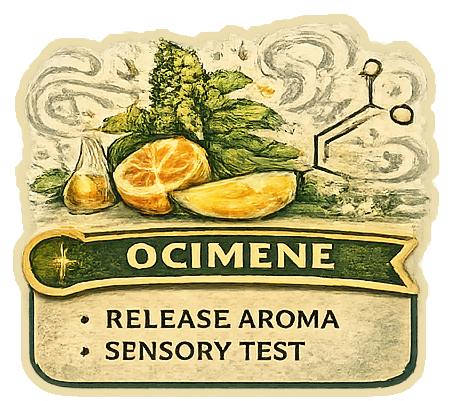 This neurological shortcut explains why aromas can instantly evoke freshness, comfort, appetite, or nostalgia – often without conscious awareness.
Few plants exemplify this aromatic potential as clearly as cannabis. Scientific research has demonstrated that cannabis exhibits an unusually broad and well-characterized range of terpene fingerprints, specific to individual strains (Booth et al., 2017; ElSohly et al., 2017). These profiles span from sharp, limonene-driven citrus notes to sweet, candy-like aromas reminiscent of bubblegum, as well as earthy, herbal, and even garlic-like nuances.
For the terpene hunter, cannabis is therefore best understood as one of nature’s most extensive aroma libraries. Importantly, these terpene profiles do not need to be extracted from cannabis itself. Companies such as Cali Terpenes analyze strain-specific terpene data and recreate these fingerprints using botanically derived terpenes, assembling them like a cookbook of aromas tailored to specific applications (Cali Terpenes, Whitepaper).
This approach allows for precise, reproducible terpene blends suitable for beverages, confectionery, savory foods, and industrial products – without regulatory complications. The terpene hunter’s workflow mirrors that of a fine-dining chef: tasting, pairing, refining, and balancing aromas for mouthfeel, persistence, and emotional impact.
Terpenes are not intended to replace traditional cooking. Rather, they expand the culinary toolkit, enabling new levels of control and creativity. As the demand for novel, sustainable, and emotionally engaging flavors grows, terpene-driven aroma design may represent the next evolutionary step in gastronomy – much as spices once reshaped global cuisine.
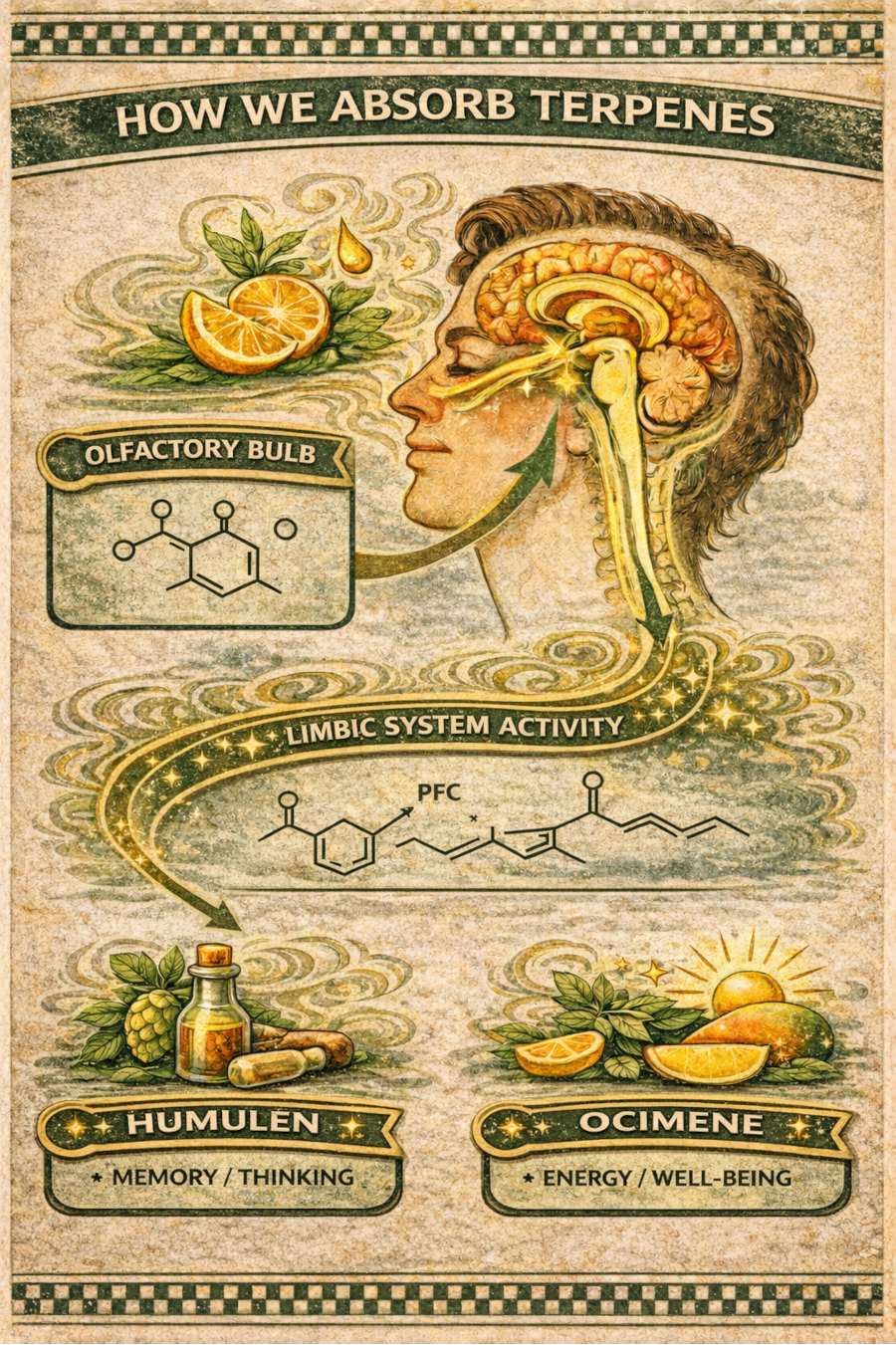
How Terpenes Work: From Inhalation to Aftereffect
Terpenes are among nature’s most refined signaling molecules. Plants produce them for protection, attraction, and communication. Humans, however, encounter terpenes mainly through smell and taste—initiating a sophisticated cascade of sensory, emotional, and physiological processes.
Routes of absorption: nose, mouth, and lungs
The primary gateway for terpenes is olfaction. Volatile terpene molecules bind to specialized receptors in the nasal olfactory epithelium almost instantly upon inhalation (Buck & Axel, 1991). Additional perception occurs retronasally during eating, while smaller amounts may enter systemic circulation via the lungs (Herz, 2009).
A direct line to the limbic system
What makes scent unique is its direct neural access to the limbic system. Olfactory signals bypass the thalamus and reach the amygdala and hippocampus almost immediately (Shepherd, 2004). These brain regions govern emotion, memory, and autonomic responses—explaining why terpenes can trigger instant mood shifts or vivid memories.
Processing in brain and body
Within the brain, terpenes influence neurotransmitter systems such as GABA, serotonin, and dopamine, depending on molecular structure and dosage (Russo, 2011). Simultaneously, their lipophilic nature allows them to circulate systemically, where they may exhibit anti-inflammatory, antioxidant, or muscle-relaxing effects (Baser & Buchbauer, 2015).
Effects on mood and health
Perceived outcomes range from mental clarity and freshness (e.g., limonene) to calming and stress-relieving sensations (linalool). Rather than acting as dominant pharmacological agents, terpenes fine-tune physiological systems, gently modulating emotional and bodily balance.
Fading effects and metabolism
Terpenes are metabolized relatively quickly, primarily by hepatic enzymes, and excreted via renal pathways (Hajhashemi et al., 2018). While their biochemical presence fades, emotional associations may persist longer due to limbic memory consolidation.
Conclusion
Terpenes do not act in isolation—they operate holistically, bridging scent, emotion, and physiology. Their power lies in subtlety: influencing perception and well-being through nuanced sensory pathways rather than overt force, making them a cornerstone of modern aroma and food science.
Essential Terpene Facts at a Glance!
🧪 What are Terpenes?
Terpenes are volatile aromatic compounds found in almost all plants. They are the primary drivers of the scent and flavor of herbs, fruits, and spices. Chemically, they are classified as secondary metabolites, serving plants in roles such as communication, defense, and attracting pollinators (Burdock, 2016).
🚫 Not intoxicants!
Crucially, terpenes are not cannabinoids. They contain no THC or CBD and have no psychoactive effects. They are globally legal and certified safe for consumption.
🧠 Why do Terpenes act so instantly?
Olfactory information is processed directly in the brain’s limbic system—the area responsible for emotions, memories, and mood. As a result, terpenes bypass cognitive filters and can trigger feelings of freshness, well-being, or appetite within seconds (Buck & Axel, 1991; Shepherd, 2004).
🍃 Why use Cannabis-derived Terpenes for Food & Drinks?
Cannabis terpenes offer an extraordinarily broad aromatic spectrum, ranging from fruity and spicy to gassy-resinous notes. They are highly relevant for food innovation because they enable novel sensory profiles without any psychoactive effects—provided they are THC-free (Booth et al. (2017): Terpene diversity in Cannabis, Plant Science).
🌿 Did you know?
No other known plant possesses such a vast documented variety of terpene “fingerprints” as cannabis. Depending on the strain, aroma profiles vary significantly—from citrusy and sweet to earthy, spicy, or even pungent (Booth et al., 2017).
🍋 What do Terpenes “convey”?
Limonene, one of the most well-known terpenes, is not only industrially sourced from citrus peels but is strategically used to convey freshness, purity, and lightness—in food and beverages as well as in fragrances (Burdock, 2016).
🔬 What are Terpene Fingerprints?
A terpene fingerprint describes the specific combination and ratio of individual terpenes that together create a characteristic aroma. These profiles can be analytically mapped and recreated using botanical terpenes—without requiring extraction from the original plant (Cali Terpenes, Whitepaper).
Note on sources, copyright, and editorial diligence
- Burdock, G. A. (2016). Fenaroli’s Handbook of Flavor Ingredients. CRC Press.
- Booth, J. K. et al. (2017). Terpene variation in Cannabis sativa. Plant Physiology.
- ElSohly, M. A. et al. (2017). Chemical analysis of cannabis. Journal of AOAC International.
- Cali Terpenes. Terpene Profiles & Strain Fingerprints – Technical Whitepapers.
- Buck, L., Axel, R. (1991). A novel multigene family may encode odorant receptors. Cell
- Shepherd, G. (2004). The Human Sense of Smell. Springer
- Herz, R. (2009). Aromatherapy facts and fictions. Chemical Senses
- Russo, E. (2011). Taming THC. British Journal of Pharmacology
- Baser, K.H.C., Buchbauer, G. (2015). Handbook of Essential Oils. CRC Press
- Hajhashemi et al. (2018). Pharmacokinetics of terpenes. Phytotherapy Research
AI-supported systems were used during the research for this article, including OpenAI ChatGPT, Google Gemini, and Anthropic Claude. AI was used exclusively as an aid. The selection, evaluation, editorial classification, structuring, and formulation, as well as the review of content and compliance with journalistic due diligence and copyright requirements, were and remain the responsibility of the publisher.